
From visit one
Pain
Calm the jaw down.
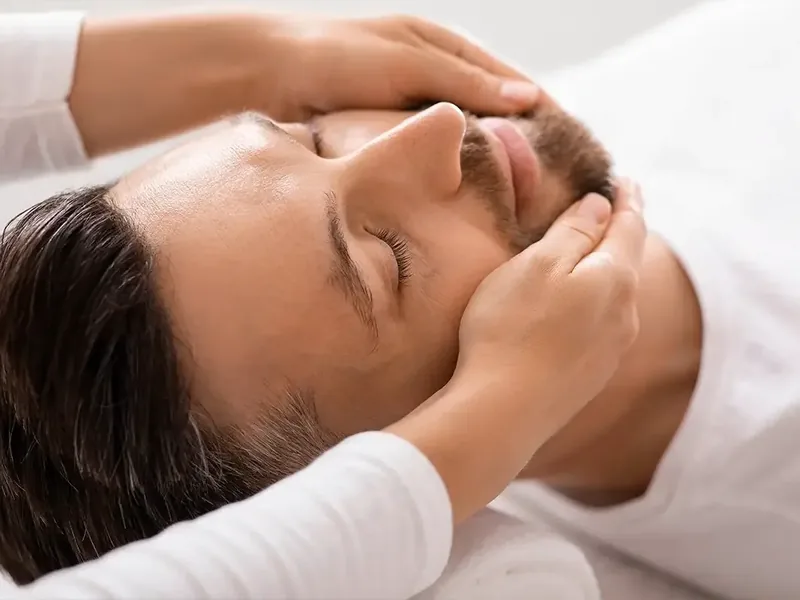
Hands-on work on the chewing muscles and the upper neck that feeds them takes the ache down, starting your very first visit.
What We Treat
The click when you yawn. The ache that turns a bagel into a decision. Jaw pain is treatable by a physical therapist, and it’s one of the things Dr. Harris treats by name. It starts with a cause-first evaluation, not another night guard.
Sound Familiar?
Two or more? Keep reading.
Why It Happens
Your jaw is a joint, and it behaves like one. Jaw pain is usually some mix of four things: the disc inside the joint sliding out of sync with the bone it rides on, which is where the click comes from. Chewing muscles that never fully switch off, from grinding, clenching, or bracing your way through a hard month. Trigger points in those overworked muscles, referring into your temple, your ear, your teeth. And an upper neck that is stiff and irritable, because your jaw and your neck share nerve territory and hand pain back and forth all day.
Which is why so many people land here after a night guard, a course of anti-inflammatories, and no real change. Those quiet things down and protect your teeth, they don’t restore how the joint moves. A cause-first evaluation measures how far you open, watches the path your jaw travels getting there, tests the muscles by hand, and checks the neck alongside it. Jaw work is not part of standard physical therapy training, and it is one of the areas Dr. Harris names on his own bio as something to come to him for.
The Honest Truth
Nobody regrets starting too early. Every week, someone in our clinic says they regret waiting.
How We Fix It
You’ve been eating around it. Chewing on the good side, skipping the crusty bread, never making it a thing anyone else has to hear about. That’s coping, not fixing. Every plan has an endpoint. Here’s what the four phases look like for TMJ and TMD.
From visit one
Pain
Hands-on work on the chewing muscles and the upper neck that feeds them takes the ache down, starting your very first visit.
Once the pain settles
Prime
Opening, closing and side-to-side motion get retrained so the joint travels a clean path instead of veering, catching and clicking.
Once motion returns
Perform
Jaw, tongue and deep neck control get built so your jaw rests where it belongs and stays there through a long meal or a long day.
Before you are cleared
Prevent
Your clenching triggers, resting jaw position, and the desk and sleep habits that reload it get sorted, so a stressful week doesn’t restart the whole thing: that’s the endpoint, not just another appointment.
Christian is professional, passionate, and incredibly knowledgeable about his craft. He takes the time to answer questions and keeps you informed every step of the way. His treatment plans are personalized to your specific needs, and you can truly tell that he is invested in your progress.
Shared by Rekyiah C. · Harris Physical Therapy patient
Before: a treatment plan built for everyone in general
After: a plan personalized to specific needs, explained every step of the way
Questions, Answered
Yes, and it is one of the things Dr. Harris treats by name. The jaw is a joint with a disc, muscles and a nerve supply, and all of it responds to hands-on treatment and retraining the way any other joint does. That means work on the chewing muscles, mobilization of the joint itself, retraining the path your jaw travels, and treating the upper neck that shares pain territory with it. Jaw work is not part of standard physical therapy training, which is why it can be hard to find. It is on the short list of things Dr. Harris names as his own.
Keep it unless your dentist tells you otherwise. A night guard is doing a real job, protecting your teeth from the force of grinding. What it cannot do is change why you clench, restore the motion the joint has lost, or calm the muscles doing the clenching. The two work well together: your dentist protects the teeth, physical therapy addresses the joint and the muscles driving it.
Because they are neighbors. The nerve supplying your jaw joint and chewing muscles shares its territory with the upper part of your neck, which is why jaw trouble so often arrives with temple headaches, ear fullness, or a ringing that got checked and came back clear. Treating the jaw on its own tends to miss half of the picture. Your evaluation covers the jaw and the neck together, a full 60 minutes, one-on-one with a Doctor of Physical Therapy.
Book Your Visit
Request a time and a real person calls you back. Not a phone tree, not ‘someone will reach out.’ Dr. Harris himself, with a plan.
5.0 · 72 Google reviews
Dr. Harris calls you back himself
Step 1 of 5
That’s the hard part done. We’ll call during business hours to lock in your time.
Visit Us