
From visit one
Pain
Calm the pain down.
Hands-on work on the irritated tendon and the tight capsule around it takes the edge off, starting your very first visit. Sleeping on that side is the first thing we want back.
What We Treat
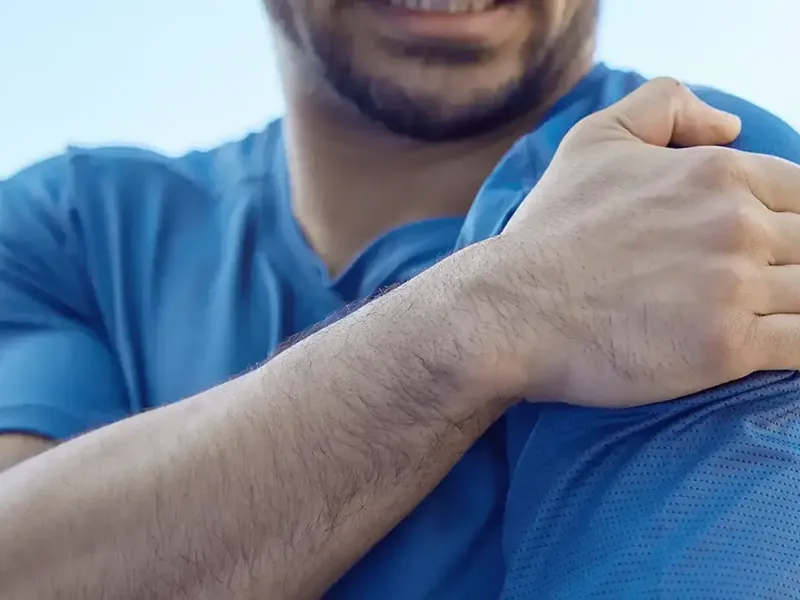
The reach into the back seat you now make with the other arm. The ache that wakes you every time you roll onto that side. It’s fixable, and it starts with a cause-first evaluation, not a guess.
Sound Familiar?
Two or more? Keep reading.
Why It Happens
The shoulder is the most mobile joint you own, and it pays for that in stability. It trades a deep socket for a ring of muscle and tendon that has to do the holding. So pain there is usually some mix of four things: a rotator cuff tendon getting pinched or overloaded. A shoulder blade that stopped gliding the way it should. A capsule that tightened up once you started guarding the arm. And a mid-back that lost the extension your arm needs to get cleanly overhead.
Here’s the part most people get wrong. The spot that hurts is usually not the spot that failed. Shoulders get blamed for what the shoulder blade and the mid-back quietly stopped doing, which is why a rest week helps right up until the first time you reach overhead again. A cause-first evaluation finds the link that actually gave out. And you didn’t leave this alone because you were careless. You worked around it for months, one small adjustment at a time, because that was easier than making it anybody else’s problem.
The Honest Truth
Nobody regrets starting too early. Every week, someone in our clinic says they regret waiting.
How We Fix It
Every plan has an endpoint. Here’s what the four phases look like for a shoulder.
From visit one
Pain
Hands-on work on the irritated tendon and the tight capsule around it takes the edge off, starting your very first visit. Sleeping on that side is the first thing we want back.
Once the pain settles
Prime
Targeted mobility restores the reach you’ve lost, and retrains the shoulder blade to glide instead of hitch halfway up.
Once motion returns
Perform
Progressive rotator cuff and mid-back strengthening builds the control your shoulder was missing before it ever started hurting.
Before you are cleared
Prevent
Reaching, pressing, and carrying get loaded and tested for real before you’re cleared to go all-in: that’s the endpoint, not just another appointment.
Christian knows his stuff, I was able to get almost full range of motion back in my shoulder after a few sessions and daily PT per Christian’s instructions. I would recommend Christian to any one feeling any pain, little or big - he will take care of you!
Shared by Jessica P. · Shoulder pain
Before: a shoulder that had lost most of its range
After: almost full range of motion back
Questions, Answered
Because lying down takes away the support your arm gets all day, and rolling onto that side compresses tissue that’s already irritated. Night pain is one of the most common reasons people finally book, and on its own it’s a clue rather than a catastrophe. It tells us how reactive the shoulder is right now, which changes how we start and how fast we load it.
That’s exactly what the evaluation is for, and the honest answer is that the two can feel very similar from the inside. Strength testing, range of motion, and how the shoulder behaves under load tell us a great deal before anyone reaches for a scan. You get that assessment one-on-one with a Doctor of Physical Therapy, every visit, and if what we find needs a surgeon’s opinion, you’ll hear that straight.
Complete rest is what turns a sore shoulder into a stiff one, and a stiff shoulder is a much longer road back. Some movements do need backing off for now. Others need to keep happening so the joint doesn’t seize up. Sorting out which is which is the work of your first visit, a full 60 minutes, one-on-one, and you leave knowing exactly what to stop and what to keep doing.
Book Your Visit
Request a time and a real person calls you back. Not a phone tree, not ‘someone will reach out.’ Dr. Harris himself, with a plan.
5.0 · 72 Google reviews
Dr. Harris calls you back himself
Step 1 of 5
That’s the hard part done. We’ll call during business hours to lock in your time.
Visit Us