
From visit one
Pain
Calm the pain down.
Hands-on work on the irritated joint and the overworked muscles around it takes the edge off, starting your very first visit.
What We Treat
The stairs you now take one at a time. The pinch in your hip crease every time you get out of the car. It’s fixable, and it starts with a cause-first evaluation, not a guess.
Sound Familiar?
Two or more? Keep reading.
Why It Happens
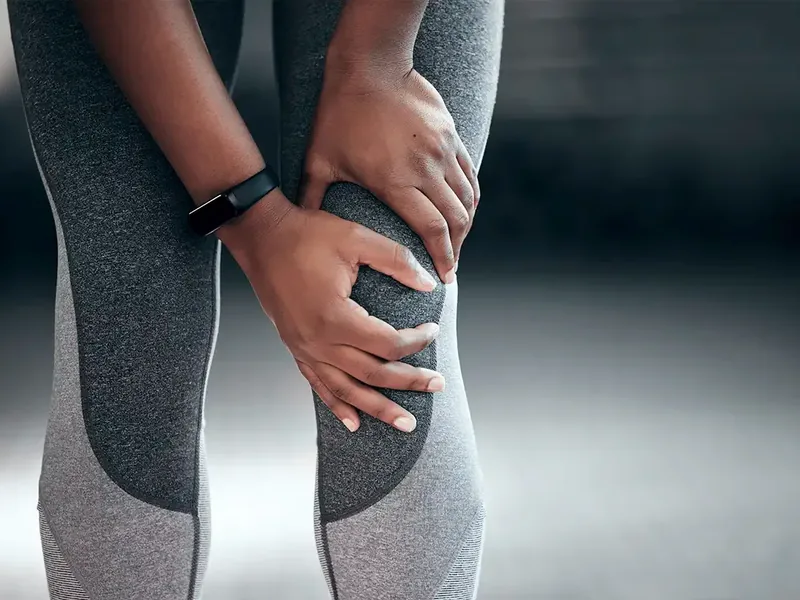
Hips and knees are a package deal. The knee is a hinge caught between two joints that rotate, so it takes the blame for what the hip above it and the foot below it are doing. Pain in either usually comes down to some mix of four things: a hip that lost rotation and started borrowing it from the knee. Glutes that stopped firing, so the thigh muscles overworked. Cartilage or tendon irritated by a load it was never trained for. And a walking pattern that quietly changed months ago to avoid something.
Which is why the obvious guess is so often wrong. Knee pain that only shows up on stairs frequently traces back to a hip that stopped doing its job. Hip pain in the crease sometimes traces back further still, to the spine. Treat whichever joint shouts loudest and you get one good week, then you’re back where you started. A cause-first evaluation checks the whole chain before deciding what to treat. And if you’ve been quietly editing your life around this, taking the elevator, skipping the walk, sitting out the hike, that isn’t weakness. It’s what sensible people do when nobody has offered them a better option.
The Honest Truth
Nobody regrets starting too early. Every week, someone in our clinic says they regret waiting.
How We Fix It
Every plan has an endpoint. Here’s what the four phases look like for a hip or a knee.
From visit one
Pain
Hands-on work on the irritated joint and the overworked muscles around it takes the edge off, starting your very first visit.
Once the pain settles
Prime
Hip rotation and full knee extension come back first, because a joint that can’t reach the end of its range can’t be made strong there.
Once motion returns
Perform
Glute and quad strengthening loads the leg through the exact positions that used to hurt, until stairs and low chairs stop being a decision.
Before you are cleared
Prevent
Walking, squatting, and whatever your version of a hike is get tested under real load before you’re cleared to go all-in: that’s the endpoint, not just another appointment.
I worked with Christian for an injury I had to my knee and back. It was impacting my ability to work out to my fullest ability. Plus, the pain was uncomfortable dealing with. Christian helped me over the course of a couple of months and I got back to good as new! A year later I’m still pain free and use the guidance and exercises he provided.
Shared by Nikki S. · Knee and back pain
Before: a knee injury cutting every workout short
After: back to full training, and still pain free a year later
Questions, Answered
No, and this is one of the most useful things to know before you book. Arthritic changes turn up on scans of people who have no pain at all, so the picture rarely explains the whole problem. What reliably changes how a hip or a knee feels is the strength and control of the muscles around it, and that is exactly what can be trained. Cartilage is not the only variable in the equation.
Often it isn’t, and that’s worth checking before you spend months treating the wrong joint. A knee sits between a hip and an ankle, and it absorbs whatever those two stop doing. So the evaluation looks at the whole leg, and the spine above it, not just the part that hurts. That’s what cause-first evaluation means in practice, and you get it one-on-one with a Doctor of Physical Therapy, every visit.
That’s the question underneath most first visits here, and the honest answer is that giving it up is the last resort, not the opening move. Loading a joint properly is part of what keeps it healthy. Your plan gets built around the thing you actually want back, and it runs through all four phases, Pain, Prime, Perform, and Prevent, so you finish by getting tested at your activity rather than told to be careful with it.
Book Your Visit
Request a time and a real person calls you back. Not a phone tree, not ‘someone will reach out.’ Dr. Harris himself, with a plan.
5.0 · 72 Google reviews
Dr. Harris calls you back himself
Step 1 of 5
That’s the hard part done. We’ll call during business hours to lock in your time.
Visit Us