
From visit one
Pain
Calm the pain down.
Hands-on work settles the irritated tendon and the guarding around it, and you get clear rules for what to load and what to leave alone.
What We Treat
The arm that comes up fine to here, then quits. The report that said tear, with nobody to explain what that means for you. Not every tear needs a surgeon, and finding out starts with a cause-first evaluation, not a guess.
Sound Familiar?
Two or more? Keep reading.
Why It Happens
The rotator cuff is four muscles whose entire job is holding the ball of your shoulder centred while the big muscles move it. Tears happen two ways. Something violent, a fall or a heavy catch, tears a healthy tendon in one go. Far more often, the tendon frays over years while it gets pinched, underloaded, and asked to cover for a shoulder blade and a mid-back that stopped doing their share.
Here’s what almost nobody explains: cuff tears turn up on scans of shoulders that don’t hurt at all, and they get more common with age whether or not there are symptoms. So a tear on your report doesn’t automatically explain your pain, and it doesn’t automatically mean an operating room. What matters is what the shoulder can still do, what the rest of the cuff can be trained to do, and whether the mechanics that frayed it are still in place. That is a cause-first evaluation, and it’s the difference between a decision and a coin flip. If you’re the one who quietly worked around this for a year so nobody had to cover for you, this is where you get an actual answer.
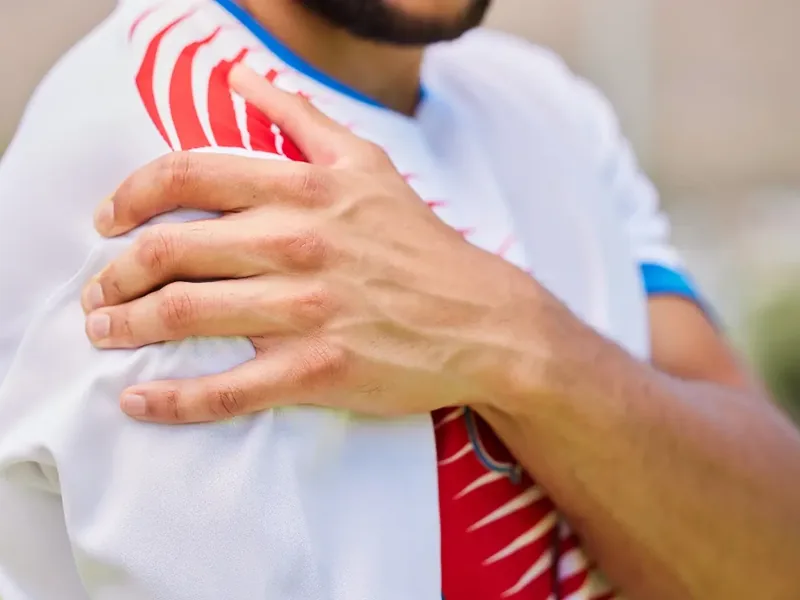
The Honest Truth
Nobody regrets starting too early. Every week, someone in our clinic says they regret waiting.
How We Fix It
Every plan has an endpoint. Here’s what the four phases look like for a rotator cuff, whether or not surgery ends up being part of it.
From visit one
Pain
Hands-on work settles the irritated tendon and the guarding around it, and you get clear rules for what to load and what to leave alone.
Once the pain settles
Prime
Range comes back first, in the directions the cuff can tolerate, so the joint doesn’t stiffen while the tendon is calming down.
Once motion returns
Perform
The intact cuff fibres and the shoulder blade get loaded progressively, until the shoulder holds its own position under weight instead of hoping.
Before you are cleared
Prevent
Overhead work, contact, and carrying get tested at real load before you’re cleared to go all-in: that’s the endpoint, not just another appointment.
Dr. Harris provided exceptional care throughout my shoulder surgery recovery and was a tremendous support during my high school football career. His combination of expertise, humility, and genuine kindness sets him apart.
Shared by Holden S. · Shoulder surgery recovery
Before: rebuilding a shoulder after surgery
After: back through a high school football career
Questions, Answered
No. Plenty of cuff tears, particularly partial ones, are managed well without an operation, and that is well established. The right call depends on the tear itself, your shoulder’s strength and range, what you need the arm to do, and how it responds once it’s loaded properly. That’s a decision worth making with evidence in front of you, rather than on the word tear alone.
Usually sooner than people expect, and always inside the protocol your surgeon set. Early protected motion is part of most repairs, not a reward you earn later. Bring your operative report and your restrictions, and the plan gets built around them, one-on-one with a Doctor of Physical Therapy, every visit.
That’s the goal, and it’s the reason the plan doesn’t stop the moment the pain does. Getting comfortable is the easy half. Getting a shoulder that holds position under real weight, overhead, repeatedly, is the half most people never finish, and it’s where re-injury comes from. Your plan runs through all four phases, Pain, Prime, Perform, and Prevent, and the last one is where your arm gets tested rather than assumed.
Book Your Visit
Request a time and a real person calls you back. Not a phone tree, not ‘someone will reach out.’ Dr. Harris himself, with a plan.
5.0 · 72 Google reviews
Dr. Harris calls you back himself
Step 1 of 5
That’s the hard part done. We’ll call during business hours to lock in your time.
Visit Us